End: Thursday, April 09, 2026•08:00 PM
The Abstract Cafe is located in the Student Union Building (SUB) at Dalhousie.Come hear about the locals history and wrap up your semester with us!
Empowering Women Through Mental and Physical Health
Submitted by Twila MacDonald
The CUPE Nova Scotia Women’s Conference, Empowering Women Through Mental and Physical Health, was held on March 6, 2026, from 1:00–4:00 pm. The conference brought together union members and leaders to recognize the importance of women’s leadership and solidarity across the labour movement. The event created a supportive space for participants to reflect on the challenges women face while celebrating the strength, resilience, and contributions of women within CUPE and the broader community.
The conference began with greetings from several leaders within the labour movement. Participants viewed a welcome video from Candace Rennick, who acknowledged the ongoing work of women in unions and the importance of collective action in advancing equity. Opening remarks were also shared by Alan Linkletter, President of CUPE Nova Scotia, along with Sherry Hiller, Tracey Pinder, and Annick Desjardins. Each speaker highlighted the importance of supporting women’s leadership within unions, advocating for workplace equity, and continuing the fight for safe and healthy working conditions for all members.
Following the opening remarks, an Equality Statement was read, reinforcing CUPE’s commitment to inclusion, respect, and equity for all members. A Land Acknowledgement recognized the traditional and unceded territories of Indigenous peoples, reminding participants of the importance of reconciliation and the responsibility of unions to support Indigenous rights and justice.
The conference also recognized International Women’s Day, honouring the global movement for women’s rights and gender equality. As part of this recognition, the Bread and Roses poem was read aloud, reflecting the historic struggle of women workers for both fair wages and dignity. Participants then observed a moment of silence to honour the victims of domestic violence, acknowledging the ongoing impact of gender based violence in communities and workplaces.
A keynote-style presentation was delivered by Patricia Perry, who spoke about her experience attending the 5th World Conference of Women’s Shelters. Her presentation, Activism Down Under, highlighted the global efforts of women’s shelters and advocates working to end violence against women. She shared insights from international conversations about survivor support, prevention strategies, and the importance of collaboration across countries and organizations. Her reflections emphasized how local activism connects to global movements advocating for safety and justice for women.
The latter portion of the conference focused on interactive and creative activities that encouraged connection, relaxation along with community building among participants. Members engaged in canvas and rock painting, tie blanket making and also casual activities such as crosswords and word searches. These activities supported the conference theme by promoting mental wellness and peer connection in a supportive environment.
Overall, the CUPE Nova Scotia Women’s Conference was a meaningful event that celebrated women’s contributions to the labour movement while highlighting the importance of mental and physical health. Through reflection, learning and shared activities, participants strengthened their sense of solidarity and renewed their commitment to advocating for equity and wellbeing for women in workplaces and communities.
This is an update you on the vote regarding whether the strike is ending. 63 people voted in total with the following breakdown:
This means that members will return to work on Monday, March 23. We are finalizing the return to work agreement with NSCAD Administration this evening and will share more when it becomes available.
Thank you to all members who showed up on the picket line in person and online making this a successful strike!
Lauren McKenzie
Once again, the CUPE NS Women’s Conference on March 6 – 7 turned out to be one of my favorite union gatherings of the year. The event had fascinating speakers, fun activities and created opportunities for us women in the labour movement to connect. This conference is
planned by the CUPE NS Women’s Committee and they take a holistic approach by making time for attendees to be inspired and to rest. The conference began with speeches from key CUPE NS and national staff and a video message from National Secretary Treasurer Candace Rennick – a favorite around here as she came to visit our MSVU and SMU strikes in the fall (with a big cheque for the local). We heard of a reading of the poem ‘Bread and Roses’ and got great gift bags to close the afternoon. That night was a reception with an amazing taco bar and drumming lesson – I had to miss this because of other responsibilities.
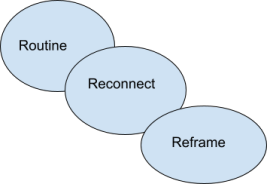
The next day, the conference heard from speakers including 4 time Olympic kayaker and local, Karen Furneaux. She spoke about her incredible career as an athlete and then the turn her life took in 2023 when she was hospitalized and diagnosed with bi-polar II disorder. Karen talked about the ‘resilience framework’. I appreciated her perspective on how having routines helped her to heal and I could relate to that. When things get really stressful with the local, I lean into my routines – going for a walk, making a smoothie, calling a sister friend…

She was so open and honest about her challenges and has written a book about her experiences. Holly and Jenna bought me a copy and Karen signed it: “To Lauren – you are the gold within” and I was so touched. Karen talked about how she had to tap into that winning spirit when she pulled up to every start line.
I had a chance to connect with my incredible 3912 sisters and women from across our province who are incredible leaders, activists, care givers, mothers, friends, partners, workers and so so much more.
Wenceslao Amezuca, MSVU Part-Time Faculty member
When I joined the Communications Committee, I did not know exactly what to expect. But very quickly it became a very positive experience for me. I met colleagues who really care about the union and the working conditions of part-time instructors. I’m not a strong activist in labour rights, but I care about issues that affect many of us, such as job security, low wages, and vulnerable working conditions. It felt good to work with people who share these concerns and are passionate about working in favour of all of us.
During the last year, our main work was to help prepare communication for our members. One of our important tasks was helping produce two newsletters that shared union news, updates, and information members should know about. We also had conversations about social media content, engagement strategies, and visual materials for communication. We discussed how to make our messages clearer and more accessible for members. Even small things, like the design of posters or infographics, can make a difference in how members receive information.
However, the biggest and most memorable moment of the year was the strikes in our Local. For me, it was an intense and unforgettable experience. There were also challenging and frustrating moments, but the process was extremely educational. I was learning by doing: writing updates, creating content, informing members, and helping share information during a very important moment for our union (not to mention the personal overexposure of being part of an ad campaign). I also had the opportunity to support the work of Katerina Allan, the very resilient MSVU Vice-President, and to see closely the leadership of our President, Lauren.
It was during the strike that I understood how important the Communications Committee can be. A strong and well-organized committee can help a lot in moments of crisis. It can prepare materials in advance, respond to unexpected situations, and reduce the stress that comes from not knowing what to do or who to contact for help.
For the future of the committee, I think it would be very useful to clearly define responsibilities. This can help avoid duplication of work and make communication more efficient. For example, it would help to know who is responsible for public communication, press releases, social media content, and who has the final word in approving what CUPE 3912 communicates publicly. Clear roles -or simply respect for the assigned roles– can help make the voice of our Local stronger, more organized, and more credible.
For me, being part of this committee has been a meaningful way to contribute to the union. When members are well informed, they feel more connected and more engaged. Good communication helps build the solidarity that we predicate among part-time instructors.
Of course, this past year, the committee could have been stronger. There were moments when we did not receive as much support as it needed (from inside and outside of the same committee). The challenges of the strike also moved different things, where the committee was not a priority. Even so, I believe we did our best to fulfill our mandate.
I am very grateful for the opportunity to be part of the committee and for everything I learned. I encourage other members to consider joining it. It is a meaningful way to support our union and to help keep our members informed, connected, and engaged.
Holly Morgan, Dalhousie Member
On March 6th and 7th, I attended the Nova Scotia Federation of Labour International Women’s Day Breakfast and the CUPE NS Women’s Conference.
The breakfast, hosted in the NSGEU building in Burnside, was enjoyable and saw the distribution of the Sister and New Sister of the Year awards. The keynote speaker was a nurse who gave an inspiring talk about resilience and support in the face of her daughter’s cancer battle. She emphasized the importance of colleagues and supervisors who care about you as an individual rather than just a worker, and about how caring for her daughter impacted her approach to nursing and to union activism.
The CUPE NS women’s conference took place in the afternoon, and the Friday sessions were primarily social. We received welcome messages from many senior CUPE representatives and were then invited to participate in a blanket tying session and to paint inspirational rocks and canvases. The evening event included African drumming and Tarot readings, and it was interesting to talk to CUPE members in healthcare and elementary education about the ongoing challenges in their fields.
Saturday’s session began with coffee, and the highlight of the morning was an inspirational talk from Carol Murray, who survived a skydiving accident in 1997 and now works in corporate fundraising. She spoke at length about resilience and how strength comes from community, and she also focused extensively on workplace safety, a matter that may have prevented her accident.
In the afternoon, we were joined by Olympian Karen Furneaux, who spoke about mental health, resilience, and recovery. Karen highlighted some of the qualities needed to overcome mental health challenges, particularly in light of ongoing strains within our healthcare system. She concluded her session by guiding us through some movement and stretching.
These events serve as empowering reminders of the important roles women leaders can play in our unions, as well as of the importance or resilience in the face of adversity. They sought to empower union leaders in challenging times and fostered strong connections across CUPE and other local organizations.
Thank you for supporting my attendance!
El Hansen, Dalhousie TA
I had the opportunity to attend the CUPE Nova Scotia Women’s Conference this year. The experience was largely enjoyable, and I was able to converse with several fellow workers while enjoying some structured motivational speakers and educationals.
While I enjoyed the event, I overall found it lacking in political activism. Much of the conference focused on ways by which we as women might face adversary and continue to struggle despite that, which was well articulated, but the overall lack of politically oriented collective action stemming from this analysis gave me pause.
In the agenda of the conference there was in fact no political action items specifically listed.
It was only because of a member from the floor who interrupted the proceedings to recommend the attendees sign a petition to the provincial government condemning the recent austerity budget cuts that political action was made an important facet of the conference. This I felt was a well-done element of our conference if a bit haphazard. But it was a shame that this was something that needed to be brought from the floor and not a core part of the conference’s political aims from the start.
This was especially true because the mood amongst the women in the room was one of justifiable anger and frustration at the provincial government and their recent attack on workers and our jobs as women. There was a recognition that something had to be done and the failure to utilize that righteous anger and channel it into political activism and education was a missed opportunity.
I hope that the future women’s conference may continue to allow for inter-local fraternization but with a greater focus on militant union action. In doing so we will continue to build a mass movement of women workers and workers generally who might advance the progressive cause.
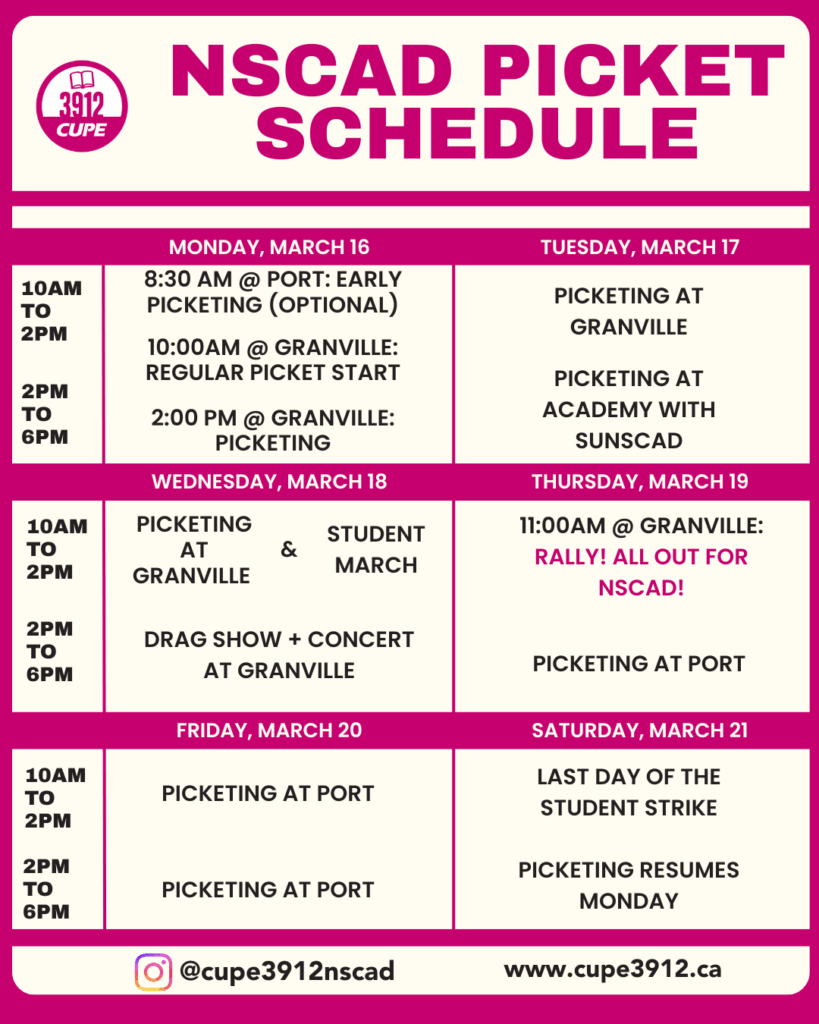
As you may have seen, NSCAD has submitted an application to the labour board requesting arbitration. Let’s be clear: This move from the employer is a sign that our strike is working!
Despite claiming that we are “not essential to their business,” after only 4 days NSCAD is crying foul and looking for an off-ramp. They want the government to take over the process that they have refused to participate in. They are seeking to achieve through government action what they have been unable to get through bargaining. They want to break our union and for everyone to just sit down and return to work.
NSCAD’s decision to pursue arbitration is disappointing, but not surprising. Binding arbitration is a process by which both parties would allow the government to appoint a third-party arbitrator with the power to impose a legally binding contract. This process effectively circumvents the bargaining process, and the Union has been given 10 days to provide a response as to whether we accept arbitration or not.
The decision to seek arbitration after only 4 days means that our strike is having an effect. NSCAD is feeling the pressure, and now they want a way out without having to make a deal. That’s why it’s more important than ever that we all show up to the picket line and show NSCAD that the only way out is to come back to the bargaining table!
We know that our demands are reasonable: They are based on what is standard practice at other universities across Halifax. We have shown our willingness to compromise toward getting a fair deal, and we encourage NSCAD to come back to the table and to do the work of bargaining in good faith.
Until then, we will continue the strike!
In the meantime, you can email NSCAD Admin directly and tell them to come back to the table.
Dear Editor,
I write to you as a concerned member of CUPE 3912, the union representing NSCAD Teaching Assistants, Research Assistants and Individual Course Appointees currently fighting for fair wages at NSCAD (Nova Scotia College of Art and Design).
I am keenly aware that — given the current news cycle — any prospect of our comparatively small fight for living wages garnering significant coverage is an uphill battle. As a society, we are swamped daily by anxiety in local and global news. In the “grand scheme of things” (a phrase which seems to proffer more underlying structure than can be truthfully located in the world today) the demands of a few hundred per contract staff at an arts university understandably flies under the radar of most people struggling to make ends meet in their day-to-day lives.
Of course, there is the economy. Gas prices. War.
And… art?
We get it, we really do. But, hear us out: NSCAD has not given us a pay raise since 1984!
To put that into perspective:
The year is 1984.
Stevie Wonder’s “I Just Called to Say I Love You” is playing on the radio, while Prince’s ‘Purple Rain’ blares on the boombox. Bruce Springsteen is letting us know he was ‘Born in the U.S.A.’
At the cinema, we choose from ‘Ghostbusters’, ‘Gremlins’, and ‘Karate Kid’. Arnold Schwarzenegger tells us he’ll “be back”.
We lose Marvin Gaye and Truman Capote that year.
The very first Apple Macintosh computer is unveiled, its design resembling a typewriter. In a now infamous Super Bowl ad referencing Orwell’s famous dystopian novel, Apple declares “You will see why 1984, won’t be like ‘1984’”. Fair enough. But, for all of us fighting for fair wages at NSCAD, it turns out 2026 is an awful lot like 1984.
Our bank statements confirm it.
Yours truly,
A worker striking in the year 2026