By Hailie Tattrie,
PhD Candidate,
Part-time Instructor
Senior Writing Centre Assistant,
Justice for Workers Member
(she/her)
Originally published in Spring Magazine.
I have been teaching at Saint Mary’s University as a part-time instructor for nearly a year and a half now. Despite this part-time status, my students never seem to notice that I am a contract worker. Why would they? I fulfill the same teaching duties as tenured professors who have been teaching for years. Although we part-timers put just as much work in as our tenured colleagues, we certainly are not treated as such. We are contract workers—it is not uncommon for us to find out we have secured a teaching contract a few days before the course actually starts. This work is incredibly precarious, the pay isn’t great, there are no benefits, and I don’t even get an office.
So, why are we doing it then? Because we love teaching. We love our students. We appreciate what little money we do get paid, and we hope that one day we will join the upper echelons of tenure-track professors. Until then, we deal with our meagre pay and continue to do our best for our students.
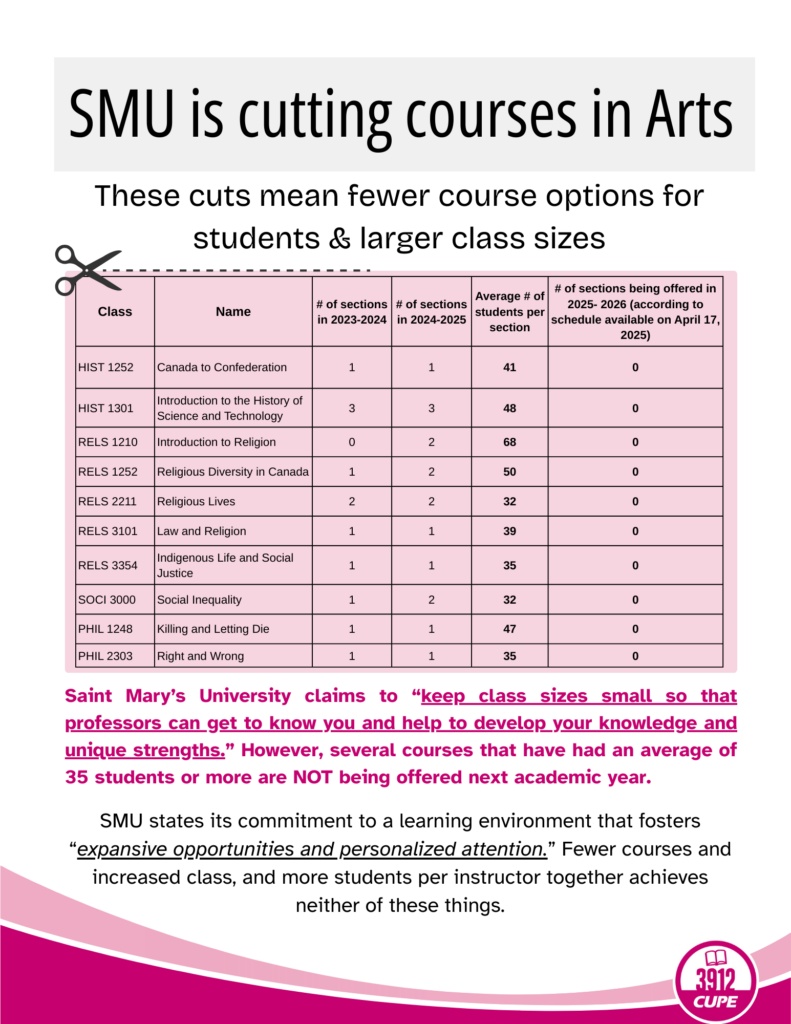
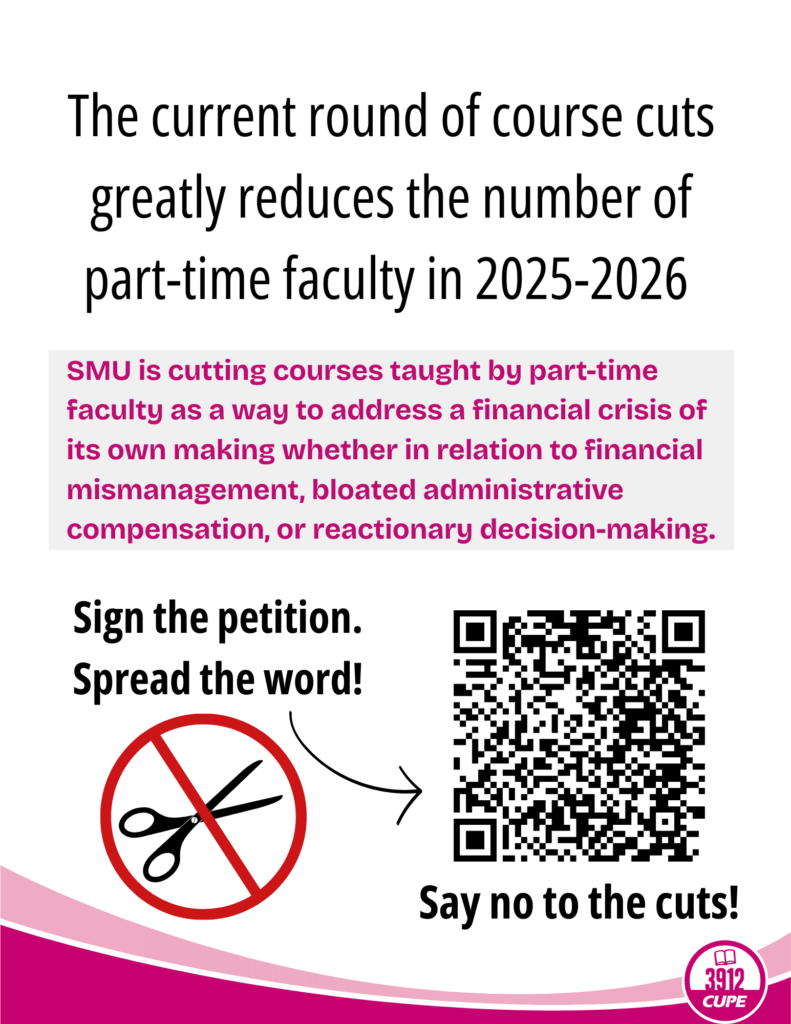
Despite our commitment (and our cheap labour), Saint Mary’s University is planning to cut 56% of part-time job offerings for the 2025-26 academic year—fifty-six percent. Art courses taught by part-timers like me will drop from 140 to about 63, resulting in about 40 part-timers losing work. I personally have yet to hear back on if I will have any courses to teach this fall.
This does not just harm me and my colleagues, but it hurts our students too. This means fewer class options for them, with some students already starting to fret over how they will graduate in time since there will be such a drastic cut in course offerings.
In addition to these cuts to part-time teaching positions and courses, we are seeing enrollment and revenue cuts, too. SMU talks about revenue and wanting programs to thrive, but continues to cut courses. Furthermore, Saint Mary’s loves to boast about its Arts and Humanities educational offerings. The University states that it “strives to cultivate an enduring spirit of inquiry, innovation, and creativity, fostering impactful research, inspired teaching, and life-long learning,” but these cuts beg to differ.
There was no warning for us part-timers or our students either; the only reason we became aware of these cuts is thanks to our union VP and a few departmental chairs.
Why the cuts?
So what is causing these cuts? Well, there are several causes. The first being the limitations to enrolling international students. There has been a 10% reduction in study permits from last year, and universities are feeling the crunch. According to the Toronto Star, the drop in permits from 2023 to now has been a whopping 45 percent. According to the Federal Government, these caps are meant to “ease the strain on housing, healthcare and other services”. However, this is just another scapegoating tactic that alleviates the government from taking responsibility and taking meaningful actions to help the housing and healthcare crises. Utilizing international students as scapegoats is not a new tactic; immigrants have been scapegoats for government failings for decades, as Miller (2023) mentions:
“Immigrants have always been blamed for the housing crisis. Look back 100 years and people were against building boarding houses because they were scared of foreigners moving in and endangering their families. Nowadays, politicians are blaming foreign investors for housing shortages, too. I’m very impatient about people pointing fingers at immigrants for the housing crisis, because it has very little to do with immigration and a lot to do with government policy.”
Bill 12
The Minister of Advanced Education, Brendan Maguire, has introduced Bill No. 12 known as “An Act Respecting Advanced Education and Research”. As the Canadian Association of University Teachers (CAUT) notes, this bill would violate university autonomy by allowing Minister Maguire to withhold grants from universities if “a university does not satisfactorily show how it is meeting the government’s social and economic priorities”. This is a threat to academic freedom and puts a muzzle on Nova Scotian universities and their faculty.
Although we have yet to see the effects of Bill 12, it does create a context for preemptive action. It could lead to further cuts down the road and increased restrictions on academic freedoms.
This reminds me of the recent instance in the United States where Trump has put a pause on educational funding for the state of Maine due to the fact that the governor of Maine continues to support the state’s anti-discrimination law that “allows transgender athletes to participate in girls’ and women’s sports”. Despite threats from Trump that he would withdraw funding, the Governor of Maine, Janet Mills, did not back down. Since Mills stood up for trans rights, her state lost educational funding. Here in Nova Scotia, universities could lose funding if they and their faculty do not meet the Houston government’s ‘social and economic priorities.’ Strikingly similar if you ask me.
Thankfully, faculty unions are pushing back against this bill, but despite this pushback, it has since passed as of March 26th, 2025.
And so the result is what we are now seeing: a cut in programs, specifically the Arts and Humanities, which are particularly under attack given the current geo-political climate. Removing these teaching opportunities is harmful to precarious part-timers like myself and our students who continue to pay the highest tuition fees in the country, yet their education is being stripped back. This attack on part-timers is an attack on the entire institution of education; it is an attack on workers’ rights and an attack on students.
Trump has stated that “Professors are the enemy” and this fascist rhetoric could be slowly creeping into Canadian discourse and government action. It may start with cuts to the Arts, but where does it end? What institutions are next? Where do we draw the line?
There are alternative cost-saving measures too—as Dr. Syed Adnan Hussain, the chair of the Religious Studies department at SMU, states in a recent CBC interview that “if there’s a revitalization conversation going on in the government, revitalization should really be about cutting administrative bloat, which almost every study about the academic sector will say is the real problem in our universities.”
It’s time that we make our voices heard and tell Saint Mary’s that we will not stand for these cuts. It’s time to cut administrative bloat, not part-timers. It’s time to stop treating universities like a business and instead like a space for learning.
 Hailie Tattrie (she/her) is a sociologist, a first-gen university student, a part-time instructor, and a PhD candidate in the educational studies department at MSVU. Hailie is actively involved in Justice for Workers Nova Scotia. She lives in Kjipuktuk with her partner and two cats.