By JP Bourgeois, CUPE 3912 Secretary-Treasurer
CAUT Defence Fund
I participated in the CAUT Defence Fund Annual General Meeting (AGM) in Montreal October 18-19, 2024. I did so as a participating member, but also a director of the fund. The difference is that a member defends the interest of the local and the director defends the interest of the fund itself.
What is this fund?
The CAUT Defence Fund allows paying organizations (which we are) a nominal benefit when we go on strike. That means, if CUPE 3912, would ever go on strike again, the defence fund would pay the local daily benefits until the strike would end.
How much will be discussed in a separate update as it is dependent on a few factors, but it is substantial, and why the executive last year voted to become participating members of the fund.
What is interesting with the CAUT fund is that the payments while on strike are done to the local, and not the members. This would allow the local substantially more flexibility in how the funds are used.
How it went
It was quite interesting to talk to other unions about the problems they faced, particularly with locals in the Maritimes. The impact of hiring freeze, immigration caps were notable topics.
The CAUT Defence Fund AGM is very specific in scope, which means it’s a 7-hour meeting about bylaw changes and elections to different committees
Joining the Investment committee
It is my pleasure to announce that I was voted on the investment committee of the defence fund for a 1-year term. I will help bring investment proposals to and do assessments for the defence fund directors. This is great news for the local as it will help us bring forth what will be an investment fund of our own to support the local.
The next CAUT defence fund AGM will be held in Ottawa in October 2025.
Applying for funds
We can apply, and are encouraged to apply early to the defence fund. It should be done before the strike vote.
CUPE money and cents conferences
The week after the CAUT defence fund conference, I was also at the CUPE money and cents conferences right here in Halifax along with the 3 trustees of the Local: Kim Robinson, James Kho, and Wenceslao Amezcua! We participated in various workshops related to finance, which were quite interesting on their own, but also gave us the opportunity to see what other problems unions faced based on their size and situations.
What was the conference about?
The conference was focused on the finances of locals and was hosted by the CUPE National treasurer, the provincial treasurers, and specialists in the field.
Topics included a workshop on budgeting, bylaws that touch specifically on finances, accessing the CUPE National fund for cost share events, and general financial literacy.
What I learned: Union structure and dues
I was most struck by the fact that CUPE 3912 is on the larger size for locals, but that we do not share in the same problems that larger unions have. Notably, we have a very large turnaround in membership, which happens when teaching assistants and part-time faculty find full-time employment. This situation is one that the other locals did not have, meaning that we need to develop a yearly onboarding process. Note that this initiative would have a financial impact on the local, but it could lead to us having more engaged and educated members.
We also learned about the types of dues that local can collect. Our local collects 1.9% of normal wages and pays a bit more than 1% to CUPE National and CUPE NS. This is on the low side of dues collection. This limits our ability to onboard members and defend our members and the local’s interest.
Remedies could be:
- Increasing dues. Since the amount CUPE National and CUPE NS take is a fixed percentage, any increase would go directly to the local. Each 0.1 percentage point would most likely generate 20,000$ more in dues a year.
- Levy an initiation fee. This could vary between 1 or 10$ for new members.
- Levy a specific purpose amount. This could be done to shore up our finances, or other initiatives.
Given that our local spends almost 95% of its budget on fixed items (dues to organizations, membership fees, administrative cost and salaries) we are left with very little money for other initiatives.
Recommendation: Do a ‘what if’ exercise to discuss what we would like to do (our dream union) and then work backwards to find the appropriate union due structure to levy. This way we would have a plan and a justification for increasing dues.
What I learned: Finance Policy
While dues are maybe a more controversial topic, this one should not be. Our local NEEDS a finance policy. Given its size and high turnover, a finance policy would help guide what can and cannot be done with finances at our local level.
It is a document which is supportive to the local’s bylaws and provides substantially more information to members, and executive. Without being afraid that the financial knowledge gets lost as treasurer or executive changes roles or from change of elections.
These are professionally prepared documents.
As the local finds itself wanting to do more events, conferences, educational events, discussions with members, the finance policy will help guide and answer questions surrounding how funds are used. Expense cards, investments, per diems/out of pocket expenses, travel, and accounting practices are but a few topics that it covers. While maybe not an exciting topic, it is a topic that takes a lot of time at the local because we don’t have such a policy.
Overall
While the CAUT Defence Fund AGM was interesting (and is a conference that we have no choice in attending), the CUPE Money and Cents conference really was the most helpful and gave me a lot of things to bring to the executive and members for more in depth discussions.
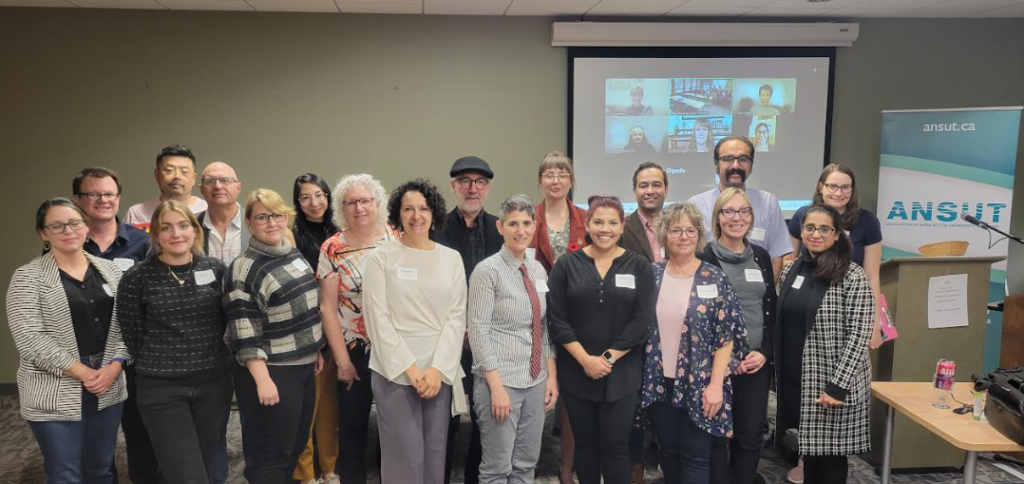 The meeting started at 9:45 A.M. with Dr. Stewart, the ANSUT president, giving a welcoming speech. It continued with Dr. Jones’s poetry reading. Then, Dr. Brigham provided a report on EDIA activities at different levels at NS universities. They did not mention our union specifically in this report. The recommendation for SMUFU is mentioned below. It may be helpful for our union as well.
 Pouya Morshedi (Ph.D. Cand.).
  Karen Harper continues her dedication and commitment to helping improve working conditions for CUPE 3912 members and contract academic staff across Canada through her roles as a member of the CAUT CAS committee (Canadian Association of University Teachers Contract Academic Staff committee). She also recently joined the committee for COCAL (Coalition of Contract Academic Labour). Her experience with CAUT is extensive, having attended numerous Council meetings, forums (for presidents, bargaining officers), webinars and workshops. Within CUPE 3912, Karen was Communications Officer from 2016 to 2019 followed by President from 2019 to 2022. She currently still helps CUPE 3912, particularly with mobilization for SMU. Karen has taught in Biology at the Mount; in Biology, Management and Environmental Science at Dal; and in Applied Science, Biology, Geography and Environmental Science at SMU. Her main motivation for being involved in the labour movement is to try to get more paid research opportunities for CAS – see her article ‘